

No one should ever receive antipsychotic drugs as a substitute for proper care. Federal nursing home regulations protect a range of resident rights designed to ensure high‑quality, person‑centered, individualized care. Central among these rights is the inherent right all nursing home resident have to make their own decisions about treatments and medications. This includes the right to be fully informed about any drug they are offered. Several resources are available on our website that help residents and their families understand the use of antipsychotic medications. Today we’re highlighting four resources.
Residents’ Rights and Facility Responsibilities explains the rights nursing home residents have regarding the use of medications, including protections that promote informed consent, clear communication, and safeguards against illegal discharge. The resource also outlines what facilities are required to do, from providing appropriate care and services, to ensuring staff are competent, to offering individualized, alternative, non‑drug interventions.
Too often, the actions or expressions of someone in distress lead to nursing home residents being labeled as “difficult.” It’s essential to remember that “difficult” is not a diagnosis, and it is never an acceptable justification for prescribing antipsychotic drugs. Facilities are required to take meaningful steps to understand and address a resident’s behavior before turning to medication. Our Advocate Fact Sheet, Difficult Is Not a Diagnosis, offers practical guidance for residents and families, including how to request a care planning conference, including a resident’s right to be present at that conference.
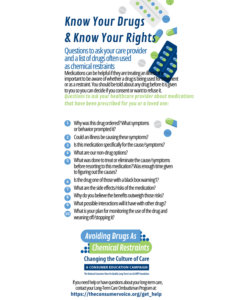
Medications can be helpful when they are used to treat an illness, but when antipsychotic drugs are considered, it is essential that residents are informed of all potential side effects and risks. Nursing home residents have the right to make their own decisions about treatments and medications, including the right to be fully informed and to determine whether the potential benefits outweigh the risks. Our third resource, Know Your Drugs and Know Your Rights helps guide residents and family members through the process of ensuring informed decisions are made by offering a series of questions to ask a care provider when a medication is prescribed. The resource also includes a list of commonly used antipsychotic medications along with their generic names, supporting residents in understanding exactly what they are being prescribed.
Nursing home residents have the right to be free from chemical restraints. A chemical restraint occurs when medication is used to control someone’s behavior or it is administered for staff convenience. Our Consumer Fact Sheet, Avoiding Drugs as Chemical Restraints, explains the warning signs in which a nursing home resident may be at risk. It reinforces key residents’ rights and emphasizes standards of good care. Most importantly, it also outlines immediate steps that can be taken within the nursing home if there is concern that a resident may have been chemically restrained.